Israel: Truth Under Fire
In this week’s update, read about how the Iran war has exposed Israel’s vulnerability to disinformation.
Also see

Israel: When the Sirens Sound, Fakes Follow
Amid conflict and polarisation, Israel's disinformation ecosystem now extends all the way to legacy media.

Israel’s Media Blindness Over Gaza
Why there’s such a gap between what Israelis and the rest of the world see on their TV screens and social media feeds.
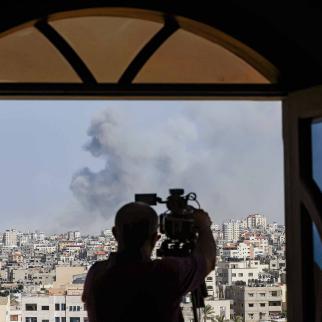
Interview: The War on Disinformation
Open source intelligence (OSINT) can provide facts – but impatient, angry audiences often prefer opinions.
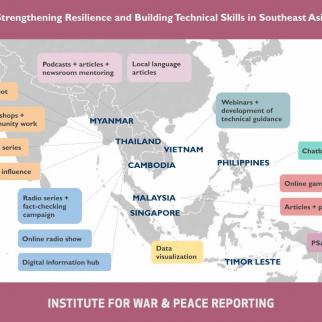
Fighting Fake News in Southeast Asia
IWPR supports partner NGOs in an innovative range of responses to the pandemic.
Israel: Truth Under Fire
In this week’s update, read about how the Iran war has exposed Israel’s vulnerability to disinformation.

Welcome to IWPR’s Frontline Update, your go-to source to hear from journalists and local voices at the front lines of conflict.
THE BIG PICTURE
Israel’s polarised society - with competing narratives around security, governance and identity - has created an environment in which manipulated content spreads rapidly.
As people increasingly turn to social media for their news, a toxic atmosphere leaves this space ripe for exploitation.
VOICES FROM THE FRONTLINE
“Military censorship, patriotic editorial norms and a media landscape under sustained political pressure have created an environment where certain narratives circulate freely while others are barely audible,” Achiya Schatz, the founder of FakeReporter, an Israeli NGO investigating disinformation, influence campaigns and digital manipulation, wrote in a piece for IWPR this week.
This “informational groupthink” meant that most citizens were no longer critical media consumers, he explained, but were instead primed to accept content “that confirmed fear, complete distrust (or blind trust) of leadership”. As the war with Iran raged, malign operations were designed to amplify those emotions.
But as FakeReporter documented a number of pro-Iranian influence operations, they also found a more surprising phenomenon. Influential pro-government figures were enthusiastically sharing malign content simply because the content served their domestic political interests, regardless of its impact.
WHY IT MATTERS
Israel’s deteriorating media environment, with shrinking space for critical voices and growing space for hate speech, allows malicious actors – both domestic and external – to manipulate public opinion.
As Esther Solomon, editor-in-chief of the English edition of Haaretz, Israel’s last surviving liberal newspaper, previously told IWPR, the country’s media largely chose to self-censor its coverage of the Gaza war.
“There’s a huge gap between the visual diet of Jewish Israelis and what the rest of the world see on their TV screens and social media feeds,” she wrote, adding, “That cognitive gap has only grown since.”
This has left what Schatz described as “a parasitic model” in which content sourced by real journalists, stripped of context and attribution, mingles with unverified material in an indistinguishable stream of highly partisan information.
THE BOTTOM LINE
Israel’s vulnerability to disinformation reflects a broader global trend in the evolving nature of modern conflict, where perception can be as impactful as reality and information resilience acts as another form of civil defence.
From eastern Europe to Africa and south-east Asia, IWPR works with local voices to build resilience and help counter the threat of malign influence operations.
“Once again, the digital battlefield is not separate from the kinetic one,” Schatz wrote. “It is the same war.”