
Israel: When the Sirens Sound, Fakes Follow
Amid conflict and polarisation, Israel's disinformation ecosystem now extends all the way to legacy media.

Also see

Netanyahu’s Never-Ending War
The Israeli leader’s virulence against Palestinian statehood has extended even unto undoing the building blocks of his own state.
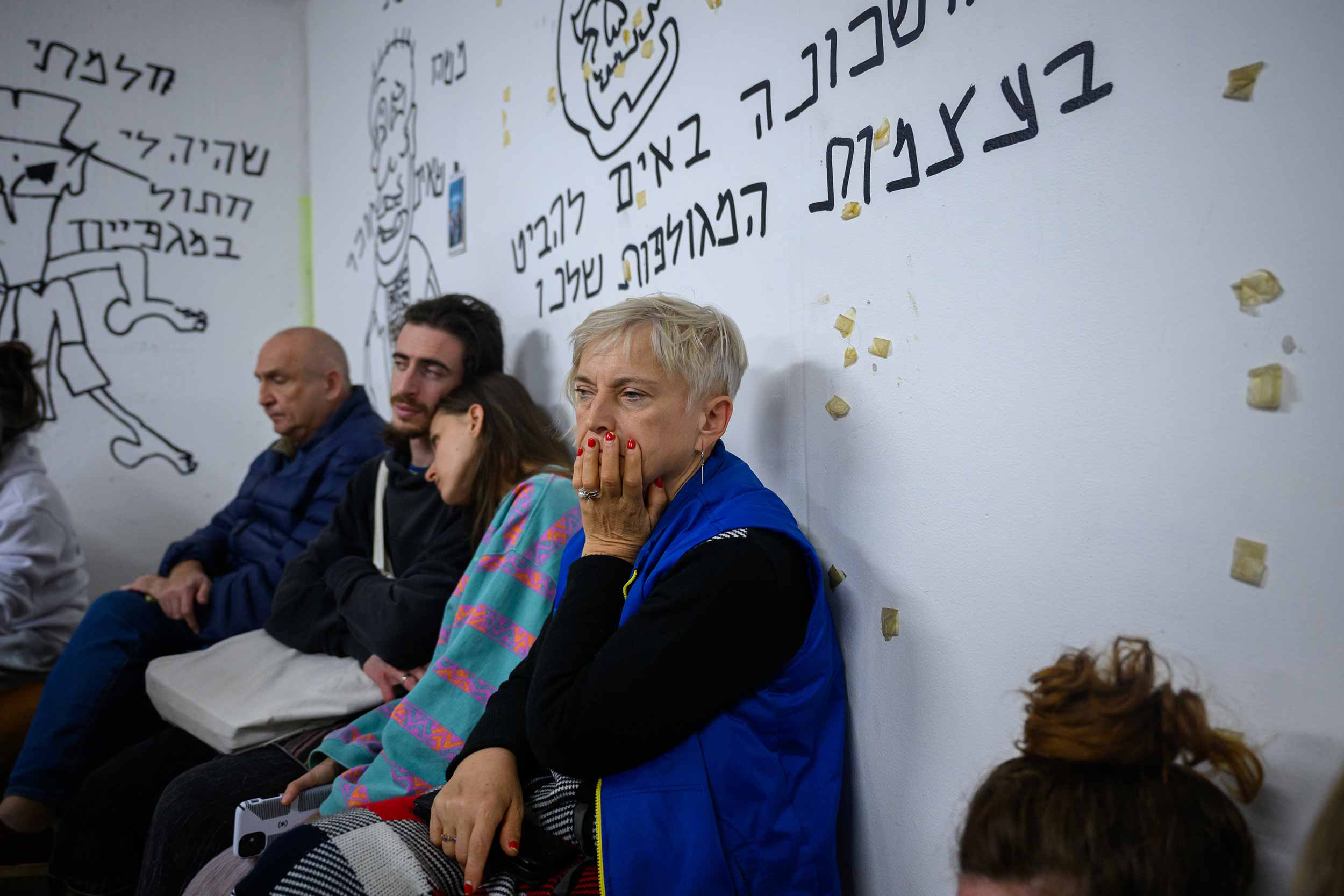
During the first days of the Iran war in late February 2026, millions of Israelis turned to messaging apps for real-time information about Iranian missile launches.
While not unusual behaviour in times of conflict, what was striking was the ecosystem that had formed around a torrent of disinformation. Israelis were not just being targeted by hostile information operations. They had, through entirely understandable behaviour, built the infrastructure through which those operations could reach them - all the way to legacy media.
FakeReporter's team has monitored and analysed the migration to messaging apps as a primary wartime news source that has been accelerating since the Hamas attacks of October 7, 2023. The Israel Internet Association now reports that 65 per cent of Israelis use Telegram. Amid security and political crises, the use of these channels rises. In the first 72 hours of the February 2026 war, popular channels gained tens of thousands of subscribers, with some crossing half a million - numbers that rival and surpass major television newscasts.
On these apps, where content is forwarded without attribution or context, the dynamics are even harder to trace. Crucially, information rapidly moves into private groups, where people no longer read it as coming from alt-news channels but from their friends and family. They rely on it and they spread it further.
The logic is straightforward: military censorship constrains official media, citizens under bombardment want information faster than institutional channels provide it, and anonymous Telegram channels - with no accountability, no obligation to verify - fill the gap. As one popular channel operator told The Seventh Eye, Israel's media watchdog: it does not matter if the news is true, what matters is that it is interesting. This is a parasitic model that feeds on content produced by real journalists, strips it of context and attribution and mixes it with unverified material in a stream that users have no practical way to distinguish from fact.
But Telegram is not merely an alternative news channel operating without regulation. It is also a space where foreign influence operations and recruiters can operate freely. The fact that Israelis have migrated to these channels in such numbers has consequences beyond misinformation exposure. In Israel, where traditional media is constantly demonised by politicians who also actively call on the public to migrate to alternative channels, such platforms are being established, captured and leveraged as political tools by Israeli lawmakers and parties. This is not new - during an outbreak of Israeli-Palestinian violence in May 2021, we documented how most Telegram channels pushing violent content were also promoting far-right politician Itamar Ben Gvir, his party and proxies. This dynamic was lucrative for Ben Gvir and contributed to his rise, the following year, to the position of minister of National Security, the very portfolio he had leveraged during those events through these Telegram and WhatsApp groups.
The result is not just a vulnerability that hostile states can exploit. It is a mechanism through which Israeli society harms itself. Every Israeli who forwards an unverified video from an anonymous Telegram channel becomes a distribution node for whatever content is circulating - including content placed there by Iranian influence networks. That content now circulates between social and traditional media as well as messaging apps.
Since late 2023, we documented the Isnad 2.0 operation, a cross-platform “popular army” influence operation. We followed a network of coordinated accounts operating in Hebrew to spread disinformation on X during the war. Its method was not to build a large audience but to reply to popular Israeli users with incendiary content - despair, incitement, calls for political violence - and let Israelis do the amplification themselves. In influence operations, you do not always need reach. Sometimes it is enough to trigger the right reaction from people who already have an audience.
This pattern is compounded by a kind of informational groupthink that makes Israeli society particularly susceptible to manipulation. Since October 7 2023, the Israeli public has consumed information within an increasingly narrow frame, with limited exposure to alternative perspectives or critical reporting on the conduct of the Gaza war. Military censorship, patriotic editorial norms and a media landscape under sustained political pressure have created an environment where certain narratives circulate freely while others are barely audible. When the February 2026 war began, Israelis who turned to Telegram were not arriving as critical consumers of information. They were arriving primed to accept content that confirmed fear, anger, complete distrust (or blind trust) of leadership - and Iranian operations were designed to amplify precisely those emotions.
Our monitoring during the war identified at least five foreign networks promoting Hebrew-language pro-Iranian messaging across X, Facebook and Telegram. The content followed three consistent lines: demoralisation, attacks on Israeli leadership and deliberate deepening of social divisions. An Iranian propaganda channel called Iran Hayom - its branding a riff on Israel's most widely-distributed newspaper - operated in Hebrew across multiple platforms. On X, research identified over 130 bot accounts generating a third of pro-regime content, with 43 per cent created in February 2026. Bot creation on X has become child’s play, making the platform the most exploitable for state-level operations. But there is another dimension to this that is perhaps more troubling.
Iran Hayom, Isnad and similar influence operations managed to get their content picked up and amplified by some of the most influential pro-government voices with hundreds of thousands of followers - not because those influencers were Iranian agents, but because the content served their domestic political interests, portraying critics of the current government in a negative light.
When we notified some of these figures that they were amplifying content from networks working against Israel, it did not matter much to them, since the material was damaging their domestic opponents. Both internal political gain for the pro-government camp and external anti-Israel objectives were served simultaneously.
All of this leads to the question of whether traditional media is performing its gatekeeping role, and the answer is troubling. During both the June 2025 and February 2026 Iran wars, major Israeli broadcasters aired unverified footage sourced from social media - old videos, AI-generated content, and in one documented case, flight simulator footage broadcast as actual bombing from Iran.
A comprehensive study by the Israel Internet Association ein the previous Iran war examining 592 fact-checks globally found that 34 per cent of Israeli fact-checks addressed claims originating from mainstream media, compared with just two per cent worldwide.
This is not a comparison that flatters Israeli journalism. Legacy media has become dependent on the same unmoderated channels its audience has migrated to, and the speed pressure of wartime reporting - competing with Telegram channels that publish instantly and without verification - has eroded the editorial discipline that was supposed to distinguish professional journalism. Israeli media published fakes without adequate checking while losing public credibility in the process, ceding it to the very sources that had deceived them in the first place.
The AI dimension accelerates all of this. Twenty per cent of disinformation flagged globally during the June Iran 2025 conflict was AI-generated, and although we do not yet have comprehensive statistics for the 2026 round, the proportion appears to have grown substantially. AI-generated videos of collapsing buildings are now difficult even for trained analysts to identify, and X's own Grok chatbot repeatedly validated fabricated content as authentic. This became a central tactic in the psychological warfare between the sides: floods of AI-generated content depicting missile strikes and extreme destruction in Israeli cities, bases, and compounds, all designed to portray a false image of devastation.
What should concern policymakers is not any single element of this picture but the way everything connects. Messaging platforms function as unregulated news infrastructure, hostile state operations are designed to exploit them, traditional media amplifies rather than filters, AI tools make fabrication trivially easy and a public conditioned by years of conflict and democratic decay plunges into the rabbit holes of the net.
Addressing this requires several things. Social media companies must accept that their platforms carry obligations as civilian information infrastructure during armed conflict, and frameworks like the EU's Digital Services Act must extend to messaging platforms like Telegram that currently evade oversight. The international community should treat state-sponsored information attacks on civilian populations with the same seriousness as assaults on physical infrastructure. The use of AI-generated disinformation against civilians must become subject to the same normative constraints that international humanitarian law applies to indiscriminate weapons. And countries like Israel need to invest in information resilience as civil defence - media literacy for wartime, fact-checking in Hebrew, Arabic and Russian, and regulation that protects citizens without silencing speech.
Not doing so serves those who benefit from the rise of anti-democratic forces in the world and within democratic states themselves.
Once again, the digital battlefield is not separate from the kinetic one. It is the same war.