
Ukraine: On the Frontline of Trauma-Sensitive Reporting
Journalists play a vital role in protecting human dignity and upholding human rights overall through survivor-centered reporting.

Also see

Iran’s Digital Darkness
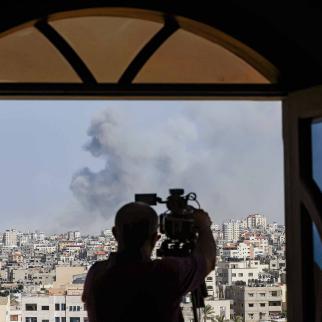
“This war is simultaneously eroding fundamental pillars of press freedom: access to information, the ability to verify facts and the safety of journalists.”

Independent Journalism in Cuba: It’s Illegal – But It Happens
Improvised newsrooms are beginning to take shape: a phone, a notebook and someone willing to tell the world what is happening.

Exiled Myanmar Media Keep Reporting Alive
The junta has systematically dismantled press freedom by arbitrarily arresting, jailing and even killing reporters as well as imposing internet shutdowns.

Myanmar: “We Continue Reporting the Junta’s Abuses”
Hybrid media outlet uses mix of diaspora staff and citizen journalists to report on events in Shan state.


Egypt: Success at a Double Cost
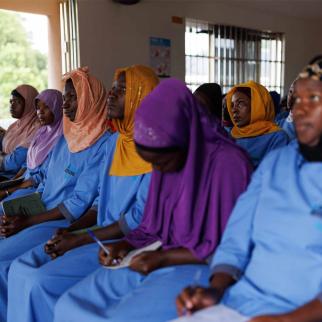
Women journalists carry an extra burden to prove their competence.
Trauma-sensitive reporting helps change a person’s role from victim to storyteller.
Following the full-scale invasion, we established The Reckoning Project as part of the Public Interest Journalism Lab and developed a clear methodology that helped us distinguish war crimes from other violations and understand how to cover them in the right way. Our collaboration with lawyers has also been crucial, giving us insight into the patterns of Russian actions.
At the core of our work is striking the balance between our journalistic duty to report on crimes and the imperative to protect survivors and witnesses from further trauma. Exposing crimes and protecting survivors or witnesses from re-traumatisation go hand and hand, not against each other. When people know their story can have a broader impact, it gives them a stronger sense of purpose in sharing it.
It is also important to limit the access of foreign and other journalists who contact us to the survivors to avoid re-traumatisation. The very essence of The Reckoning Project is: Speak with the survivors once, at length and in an appropriate setting.
Through our model, the person is able to tell their story one time, and we use their testimony repeatedly without going back to them. If we need to update their story several years later, we don’t ask them to repeat the most horrific details. We return only with questions for an update - how the person is doing now, how their case is progressing and how their life is now.
Notably, we don’t need to identify individuals even though they have signed consent forms for their testimonies. The large body of anonymous testimonies allows us to write analytical reports and reference a high volume of similar accounts from survivors without naming them-- a significant advantage for our work.
“A properly conducted interview can help transform a cloud of pain – a traumatic experience – into a structured narrative. It effectively changes a person’s role from victim to storyteller."
The sheer scale of war crimes, witnesses and survivors is so immense that we have no need to approach people who are reluctant or hesitant to speak. The real challenge is reaching the vast number of people who are willing to talk.
As a practitioner of trauma-sensitive reporting, I focus on how we interact with victims, survivors and witnesses of war crimes: This shapes whether our communication re-traumatises them or, conversely and more importantly, empowers them to share their traumatic story and begin to separate themselves from that experience.
I strongly believe that a properly conducted interview can help transform a cloud of pain – a traumatic experience – into a structured narrative. It effectively changes a person’s role from victim to storyteller. In our context, the Russian war criminals become the villains of that story.
Part of our work in trauma-sensitive reporting is dealing with sceptical audiences. Since 2014, we have consistently encountered ethnic, religious and gender-based prejudice. For instance, part of my job at Hromadske involved dealing with significant internal divisions. We had to part ways with many people because they were actively sowing discord and promoting prejudice, particularly against those from the so-called occupied territories.
There are many such examples in the Ukrainian media landscape. We see a lot of media figures and even Ukrainian officials, who have actively promoted hate speech and prejudice against certain communities.
Building – and sustaining – the trust of survivors and witnesses entails a combination of professionalism and genuine empathy. This is a skill that some can be taught, but others simply cannot.
In fact, I learned through time that all it starts with creating a comfortable environment, giving the person a sense of control, allowing ample time and having a structured beginning and end to the interview. You guide the person back to the present, to small, everyday things, so they aren’t left dwelling in the past.
Trauma-sensitive reporting also means giving them the option to stop the interview, the ability to ask for clarification and maintaining an open line of communication.
We are particularly careful when working with children: We never insist. There are times when parents themselves might ask their children to add something and we are the ones who suggest that perhaps it’s not necessary. In other words, we often have to be the ones to set boundaries. We have a very clear protocol for communicating with survivors, which aligns with the best practices promoted by trauma journalism centres.
Unfortunately, not all do their jobs this way. Some journalists, especially those with an investigative background, still conduct interviews in a prosecutorial, interrogation-like style, which I find quite strange. While there are specific questionnaires for journalists documenting war crimes that help define the quality of the conversation, the most crucial element is simply having enough time. You cannot rush these interviews or conduct them without being completely focused on the individual.
As a trauma-sensitive reporter, being fully present is key – without distractions from your phone – and one must have to have the emotional and mental capacity for it. Experience tells us that three such interviews in a day are the absolute maximum and even that is a lot. If you feel your own empathy starting to wane, you need to take a break. It is a sign that you might be burning out from this kind of work and that needs to be handled with care.
Journalists are able to do their trauma-sensitive reporting very well when they have sensitive editors who understand how these complex issues work.
In our work in providing training to Ukrainian newsrooms, my team and I learned that there are editors who are so unprofessional they believe you can interview the mother of a deceased soldier or a person who has survived torture over the phone. That is a terrible example of editorial work. On an institutional level, if a newsroom can’t pay for a journalist’s ticket to travel from, say, Kyiv to Vinnytsia and give them a day for it, then that newsroom is better off not working on these topics.
This is why a newsroom’s institutional capacity to handle sensitive topics is so critical. It means having the systems in place to work on these stories carefully, to not rush them for a next-day deadline and to give survivors the chance to review the article and time to process everything. Moreover, an editor can unilaterally slap on a terrible, harmful headline – a decision that is entirely out of the journalist’s hands.
The true foundation of a journalist’s resilience is community. It is having colleagues and editors to turn to and having a safe space in the newsroom to talk through the emotional toll of the job. It’s about being able to voice the hurt of being insulted by the people you are trying to help, of being accused of profiteering from their pain or being asked for money in exchange for a story.
When journalists can openly process these experiences as a team, the relief is immense. The opportunity to debrief in meetings and informal chats is, I believe, the single most powerful tool we have.
Finally, journalists like us are driven most when we see the impact of our work – that our stories are being read, shared and are having an effect. The knowledge that we have made a difference for someone helps alleviate the trauma.