Tehran’s Loyalty Pageant
In this week’s update, read about the complex truth behind Iran’s pro-regime demonstrations.
Also see

Tehran's Carnival of Resistance
In the centre of the Iranian capital, a nightly pro-regime rally has been going for nearly three months.

On the Streets in Tehran
“Together we were magnificent and dignified. Then the killing began.”

After Khamenei: Iran’s Uncertain Future
We are witnessing a political system confronting unprecedented shock while leaning on long-standing survival mechanisms.

Iran’s Digital Darkness
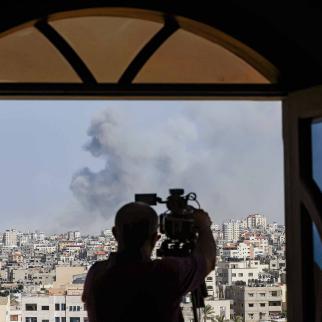
“This war is simultaneously eroding fundamental pillars of press freedom: access to information, the ability to verify facts and the safety of journalists.”
Tehran’s Loyalty Pageant
In this week’s update, read about the complex truth behind Iran’s pro-regime demonstrations.

Welcome to IWPR’s Frontline Update, your go-to source to hear from journalists and local voices at the front lines of conflict.
THE BIG PICTURE
As the conflict involving Iran, Israel and the US enters a new phase, images of pro-government rallies in Tehran – with flag-waving crowds denouncing foreign intervention - feature prominently in state media.
However, their political significance is more complex than first appears.
VOICES FROM THE FRONTLINE
“These days, central Tehran’s busy Tajrish Square market packs up early,” a writer based in the capital wrote this week. “Those who come looking for seasonal wild garlic or rhubarb leave before the evening call to prayer, surrendering Tajrish to the tangled night-time traffic of flag-waving pro-regime convoys.”
Every night for nearly three months, he continued, “the square belongs to revolutionary men and women keeping the flag of the Islamic Republic aloft”.
Yet all is not as it seems.
“For nearly five decades, the Islamic Republic has successfully kept the streets under the control of its supporters,” a 48 year-old journalist in Tehran, who asked to remain anonymous, told IWPR. However, the gatherings held after the outbreak of the war reveal striking changes that may signal serious political shifts.
“For example, during pro-government rallies, women without head coverings were visibly present. This is despite the fact that less than four years have passed since the Woman, Life, Freedom movement, which emerged in protest against compulsory hijab.”
He continued, “The imperative of preserving the regime has led to the replacement of strict values - for which many lives have been taken - with the slogan ‘We are all Iranians.’”
WHY IT MATTERS
State media highlights pro-government rallies as evidence that war is uniting the nation, but Iran's long-running domestic problems have not disappeared.
The country entered the current conflict after months of severe inflation, political unrest and anti-government protests.
Analysts continue to describe deep dissatisfaction with economic conditions and governance, while rights groups report a heightening crackdown.
“Iranian authorities are using the cover of what they call ‘wartime conditions’ to intensify their repression of dissent through mass arbitrary arrests, accelerated grossly unfair judicial proceedings, politically motivated executions, harsh prison sentences, and asset confiscations,” a recent Amnesty International report warned.
The Tehran journalist warned that conditions could deteriorate even further.
“The government appears to be testing a form of identity redefinition -a shift from ‘the Islamic Republic against the enemy’ to ‘Iran against the enemy,’” he continued. “This could lay the foundation for a new form of authoritarianism in which nationalism carries equal or even greater weight than religion.”
THE BOTTOM LINE
In a highly contested information space, the visibility of pro-government rallies is useful for regimes to not only signal strength to foreign adversaries but also to reassure supporters, security forces and elites of their firm control.
In Iran, where a total internet shutdown was only eased late last month, controlling the narrative remains key.
“This war is simultaneously eroding fundamental pillars of press freedom: access to information, the ability to verify facts and the safety of journalists,” Faramarz Dabir, the pseudonym of an Iranian journalist, wrote for IWPR last month.
Amid crisis, local voices - often risking severe consequences - are vital to reveal the true complexity of events on the ground.