
After Khamenei: Iran’s Uncertain Future
We are witnessing a political system confronting unprecedented shock while leaning on long-standing survival mechanisms.

Also see

“The City Feels Terrifying”
The question that occupies all our minds is: what is going to happen?
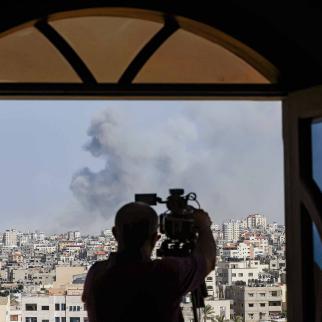
The Middle East is caught in a widening arc of war. Israeli and US strikes against Iran have turned the country’s skies into a continuous and unyielding canvas of fire with thousands of bombs striking targets across the country. The destruction spans a broad spectrum of military, governmental, and civilian infrastructure, from Islamic Revolutionary Guard Corps (IRGC) command posts, missile installations, air defence networks and naval assets, to state television facilities, local police precincts, border guard posts, oil depots, airports, schools, and medical centres. An early strike on the Supreme Leader’s compound resulted in the death of Ayatollah Ali Khamenei, ending his nearly four decades of rule. Mojtaba Khamenei now succeeds his assassinated father.
Iran’s multi-layered campaign has seen it firing hundreds of missiles toward Israel, striking US assets across the region, and targeting facilities in Bahrain, Kuwait, Oman, Qatar, Saudi Arabia and the UAE. Iranian drones and other munitions, as well as the interceptors fired to neutralise them, have also hit civilian infrastructures such as airports, hotels and energy facilities. IRGC has effectively closed the Strait of Hormuz, a waterway through which about 20 per cent of the world’s crude oil and natural gas passes.
Hezbollah joined the conflict by launching its own aerial campaign against Israel. Israel responded with additional airstrikes and a ground incursion into Southern Lebanon. The situation is chaotic, to put it mildly. Across the region, casualties are mounting, with civilian and combat zones of war quickly becoming indistinguishable.
So where does this leave Iran? What will it come of its political future and its ruling regime?
Historically, it is important to situate ourselves within Iran’s longer political timeline and recognise that this is a unique moment, with the killing of the Supreme Leader representing a consequential rupture. Iran has long endured imperial influence; foreign troops have occupied parts of the country, military and political elite have been assassinated by external forces and great powers have acted as kingmakers. However, the direct killing of a head of a state is unprecedented. In this sense, we are traversing uncharted waters.
Yet crisis reveals past patterns as much as it may create new frameworks. Amid the current war, the political elite in Iran have relied on institutional plans and governing structures in an effort to consolidate consensus, control the security environment and manage public perception. We are witnessing a political system confronting unprecedented shock while leaning on long-standing survival mechanisms. Understanding the interaction of these dynamics is critical to assessing Iran’s short-term political stability. Conditions are extremely volatile, and the unrelenting bombardment may still bring collapse, but so far the regime shows no serious signs of faltering.
Despite the constitutional provisions outlining a clear appointment path, leadership transitions, as evidenced by Khamenei’s own rise, are less procedural and more a matter of elite bargaining and power politics within a close circle of regime insiders. Mojtaba Khamenei is widely understood to maintain close ties with key regime insiders, including figures within the IRGC and elements of the state’s entrenched security apparatus. However, he lacks extensive bureaucratic experience, past executive roles and the kind of leadership background typically forged in wartime or major state crises. In the current wartime context, these limitations make it unlikely that he would immediately assume full operational control. For all intents and purposes, the Supreme National Security Council has and will continue to manage the country without direct supervision from the leader. So, while Mojtaba Khamenei’s appointment is important, it was not as immediate of a necessity for regime survival as some may think.
Regime Durability
The Islamic Republic is arguably more vulnerable than at any time since its inception. On the heels of January’s protests and the regime’s massacre of thousands of demonstrators, its popular legitimacy has eroded. It has faced a severe economic crisis, international sanctions and now direct military confrontation. The assassination of its Supreme Leader appeared to constitute an existential blow. Yet, so far, the system has not fractured. There have been no visible elite defections. The security forces remain cohesive. Reformist and conservative factions have largely closed ranks in the face of foreign attack. Regime insiders have not fled. The machinery of repression remains intact. This durability reflects a structural reality that is often misunderstood abroad. The Islamic Republic is not simply a personality-driven autocracy, but an institutionalised system with complex and well-rooted appendages. Intellectual historian Mehrzad Boroujerdi put it well by saying that the Islamic Republic was never a “one-bullet state.”
The clerical establishment, the judiciary, parliament, economic foundations, intelligence services and the IRGC form a dense web of overlapping elected and unelected power centres that together preserve and stabilise the system. Authority is distributed, layered and mutually reinforcing. The Supreme Leader sits at the top, but the system does not rely solely on an individual. For nearly four decades, Ali Khamenei consolidated power through political manoeuvring, but the institutions beneath him also bolstered his longevity. Each of the system’s bureaucratic and security institutions have their own entrenched interests as well. For example, over the years, the IRGC has evolved into not only a military force but also an economic, political, social and strategic pillar of the state, employing long-term planning and vision in preparation for moments like this crisis.
A case in point is the IRGC’s current decentralised command structure, which has been decades in the making. Tehran adopted what it calls a “mosaic defence,” empowering regional and provincial commanders to act autonomously should central communications be disrupted or authority become ambiguous. Contrary to some experts’ claims, autonomous actions by mid-ranking officers are not signs of collapse or improvisation but a part of Tehran’s military doctrine. The canon is grounded in history, geography and asymmetric warfare theory. Its goal is to ensure that Iran’s military remains operational and unpredictable even if central command is destroyed. This decentralised approach amid crisis is also echoed in the country’s political administration, with figures such as President Pezeshkian aiming to empower provincial governors and regional officials to do their own executive decision-making.
Given these dynamics, signs point to a further consolidation of a security state in Iran. This is a governing model that prioritises national defence, extensive citizen surveillance and internal order above other policy concerns. This phenomenon had already started but will only intensify under wartime conditions. When a state perceives its survival is at stake, coercive institutions gain leverage. This does not imply a formal military takeover, however. Iran’s political system is unlikely to abandon its clerical framework anytime soon. But it does mean that Mojtaba Khamenei is likely to govern in a more securitised environment, relying heavily on intelligence and military institutions. This shift carries significant consequences. It narrows the space for political reform, reinforces hardline narratives and risks further alienating a society already weary from economic hardship, repression, and unanswered demands for sociopolitical freedoms. A security-dominated transition may suppress dissent in the short term, but will not resolve underlying grievances. Such a model can temporarily preserve order at the cost of widening the already substantial gap between state and society.
We are living through one of the darkest periods in Iran’s contemporary history. The fate of a nation of more than 90 million people hangs in the balance. The population inside the country is enduring bombardment by foreign aggressors while dealing with domestic oppression, with little glimpse of light within the immediate future. Unlike the hopeful cheers of those who believe that a better tomorrow could be delivered by bombs, I do not see clarity nor closure in this moment. If anything, its brutal reality is only a sober reminder of how quickly force can reorder a political landscape without resolving the deeper and layered social, cultural, and economic anxieties beneath.
The assassination of a sitting leader, the regional spillover and the hardening of Iran’s security apparatus may reshape the balance of power in the short term, but they will not answer the more fundamental questions. War can disrupt, eliminate individuals, and redraw strategic calculations, but it cannot magically conjure up a stable political future. For now, I count the dead and hope that the next bomb will be the last.