Ukraine: The Critical Infrastructure of Trust
Media and information must form integral elements of security, recovery and reconstruction.

Also see

Dying for the Truth
Despite overwhelming international condemnation, Israel continues to try to maintain an information vacuum in Gaza.
Ukraine: The Critical Infrastructure of Trust
Media and information must form integral elements of security, recovery and reconstruction.


We make a distinction between soft power and hard power, but let’s remember, especially in the city of Gdańsk, of all cities, that soft power is real power, and that’s really what matters.
So, it is a tribute to the accomplishments of Ukrainian journalists, who have played a truly important, even spectacular role. There are significant numbers of Ukrainian media houses that have suffered evacuation and closure, damage and of course loss of life.
But it’s not just that Ukrainian media are writing the history of this war for Ukraine. Every single piece of news that you will receive about Ukraine will pass through the support and help of Ukrainian journalists.
Whether it’s written by a Ukrainian journalist or has been ‘fixed’ or researched or translated by a Ukrainian journalist, Ukrainian journalism is writing this war and writing this war story, and obviously they need more support.
If I wanted to leave you with one phrase, I would say that trust is critical infrastructure.
This is a conference about recovery and reconstruction. We’ve talked about roads. We’ve talked about security. We’ve talked about finance. Trust is the critical factor.
The amazing thing is that it is incredibly inexpensive. If we’re talking about 600 billion US dollars as a possible overall cost according to the World Bank, by various estimates the amount required to recover the Ukrainian media is less than one tenth of one per cent.
Less than one tenth of one per cent. This is remarkably cheap compared to the benefit it brings.
What is Russian propaganda about? The information campaign is part and parcel of the Russian war campaign. It’s not either/or. It is a unified strategy. It’s called active measures. The Soviet Union did the same. Nothing has changed.
Many of us debate whether the war in Europe is going to start or it’s not going to start. I live in London. Are we under attack?
Yes, we’re under attack now. It’s an information attack, absolutely. It’s well resourced. And it has lots of advantages. One of these is that it never tries to achieve anything positive, only negative. It just tries to pull down.
Nataliya Gumenyuk – the prominent Ukrainian journalist and recently a project partner with IWPR – explained it very clearly yesterday, so let me recall her remarks. The purpose of this cognitive warfare, she explained, is to teach us that we cannot do anything. It preaches cynicism and negativity, so that politicians don’t believe in elections, military don’t believe in war, lawyers don’t believe in law, journalists don’t believe in media. Ultimately the purpose of the Russian information campaign is to make Ukrainians not believe in Ukraine.
Clearly it hasn’t worked, and one of the reasons is because of Ukrainian journalism. So that’s where we need to focus our support – our countermeasures, if you will.
At the Institute for War & Peace Reporting, our work has focused on three areas.
The first has been core media support. We’ve worked with Reporters sans Frontiers and many of our wonderful Ukrainian media partners in the room to provide funding and flak jackets, safety and security training, psycho-social support. These are really important human and resourcing needs.
The second part is specialist training and skills in investigative journalism and other areas. This has focused on training and funding war crimes reporting – helping to establish the Reckoning Project, and the critical area of reporting on war crimes justice processes. There are over 200,000 war crimes cases. Each case results in a process and that process must be reported fairly and accurately. We continue to build this expertise.
The third area, which is currently our largest program, with thanks for generous support from Norway and our good friends at NORAD, is accountability.
Let me be clear here. Good governance is not anti-government. Good governance is transparency. Good governance is efficiency. Good governance is making reconstruction funds work better. And good governance is above all about bringing the society together to understand the value of the reconstruction funds, give confidence in the process and procedures of how it’s being allocated, and ensure that allocation is done well and show the difference it makes.
In our programme, over the past year, we’ve allocated around 1.5 million euros in sub-grants. We’ve worked with 40 or 50 local partners, supported the production of 2,000 pieces of content, achieving more than 17 million views.
And this transparency has improved effectiveness in more than a quarter of a billion dollars in allocated procurement contracts. So, transparency works and improves the system.
These are not only media outcomes, these are reconstruction outcomes.
We need to support the Ukrainian media for the heroism that they’ve shown and to provide them what they need to recover.
We need to support them also for this vital work of transparency in the recovery. This entire conference is about mobilising enormous sums, and we need to make sure those funds are spent well, seen to be spent well, and felt to be spent well. That critical infrastructure of trust will deliver this.
We know how to do it. We’re doing it. The Ukrainian journalists are doing it. And it doesn’t even require that much money, but the money has to be delivered.
The really important thing is this war has actually been won. Russia has failed because it has not destroyed the Ukrainian state. It’s not over yet, but this war will end, and it will end in victory.
Yet let’s win the peace, too.
When peace comes, Ukrainian society will have to become more open, and Russia will take advantage of that.
So, there is paradoxically an enhanced risk of peacetime in this information warfare. We need to come together to deliver funds for now, but we also need careful strategies with Ukrainian media partners and our donors and the Ukrainian government to win that peace as well.
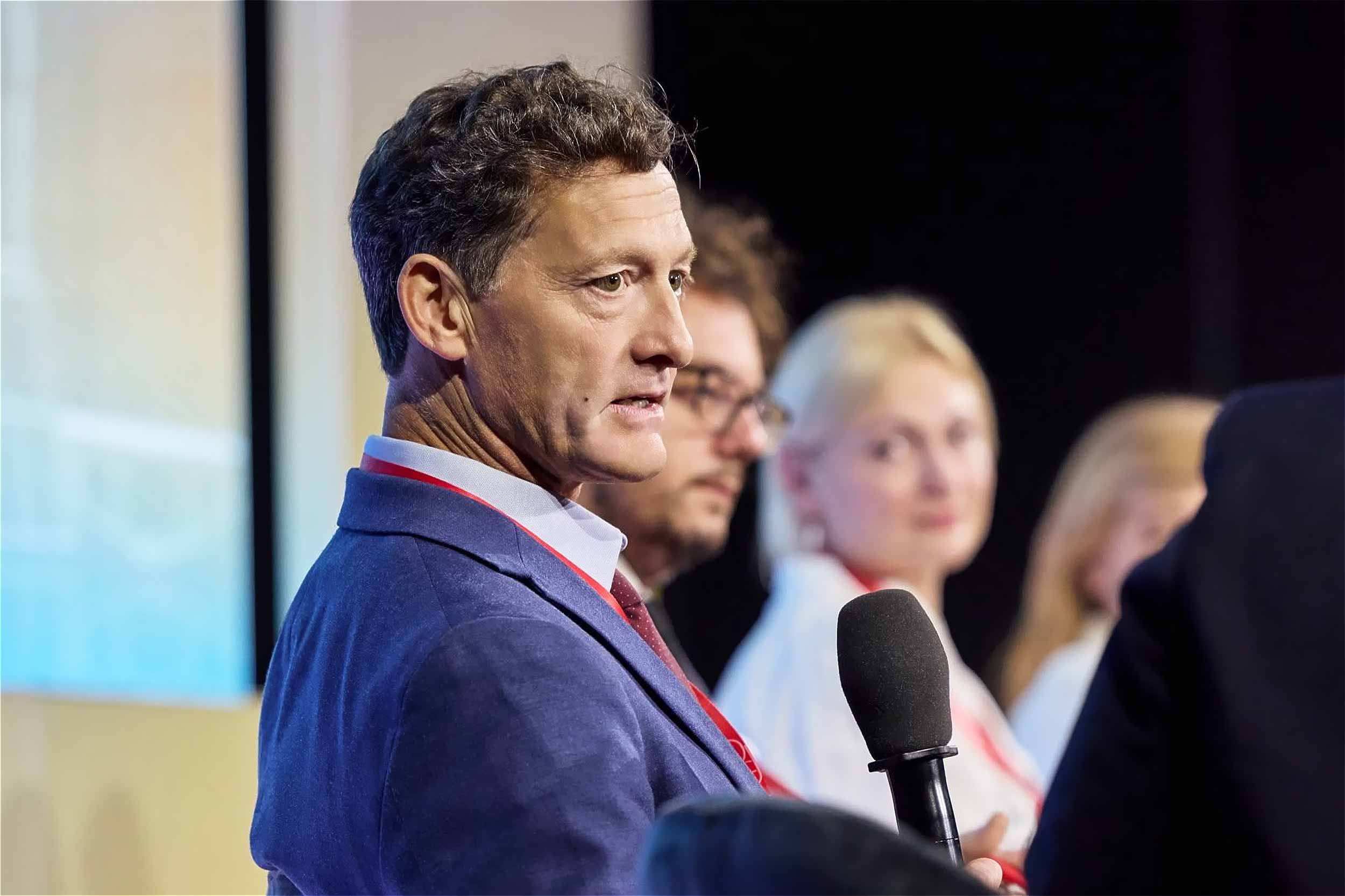
This is an edited version of an address given at the 2026 Ukraine Recovery Conference in Gdansk, Poland.