Reporting War Crimes in Ukraine
In this week’s update, read about IWPR’s new resource for conflict-sensitive reporting on war crimes in Ukraine.
Also see

Ukraine: Justice in Times of War
Kyiv event brings together media, human rights defenders and international experts to discuss ethical journalism and accountability.
Reporting War Crimes in Ukraine
In this week’s update, read about IWPR’s new resource for conflict-sensitive reporting on war crimes in Ukraine.

Welcome to IWPR’s Frontline Update, your go-to source to hear from journalists and local voices at the front lines of conflict.
THE BIG PICTURE
As the full-scale invasion continues, Ukrainian journalists are documenting an ever-growing number of war crimes.
Yet the urgency to record atrocities must be balanced with the imperative to report responsibly.
A new IWPR handbook provides a practical guide to conflict-sensitive reporting on war crimes with a strong focus on local Ukrainian voices and experience.
VOICES FROM THE FRONTLINE
“In conflict-sensitive reporting, how journalists interact with victims, survivors and witnesses of war crimes is crucial: whether their communication re-traumatises them or, conversely, empowers them to share their story and begin to separate themselves from that traumatic experience,” journalist Nataliya Gumyenuk, CEO of the Public Interest Journalism Lab, wrote in the handbook.
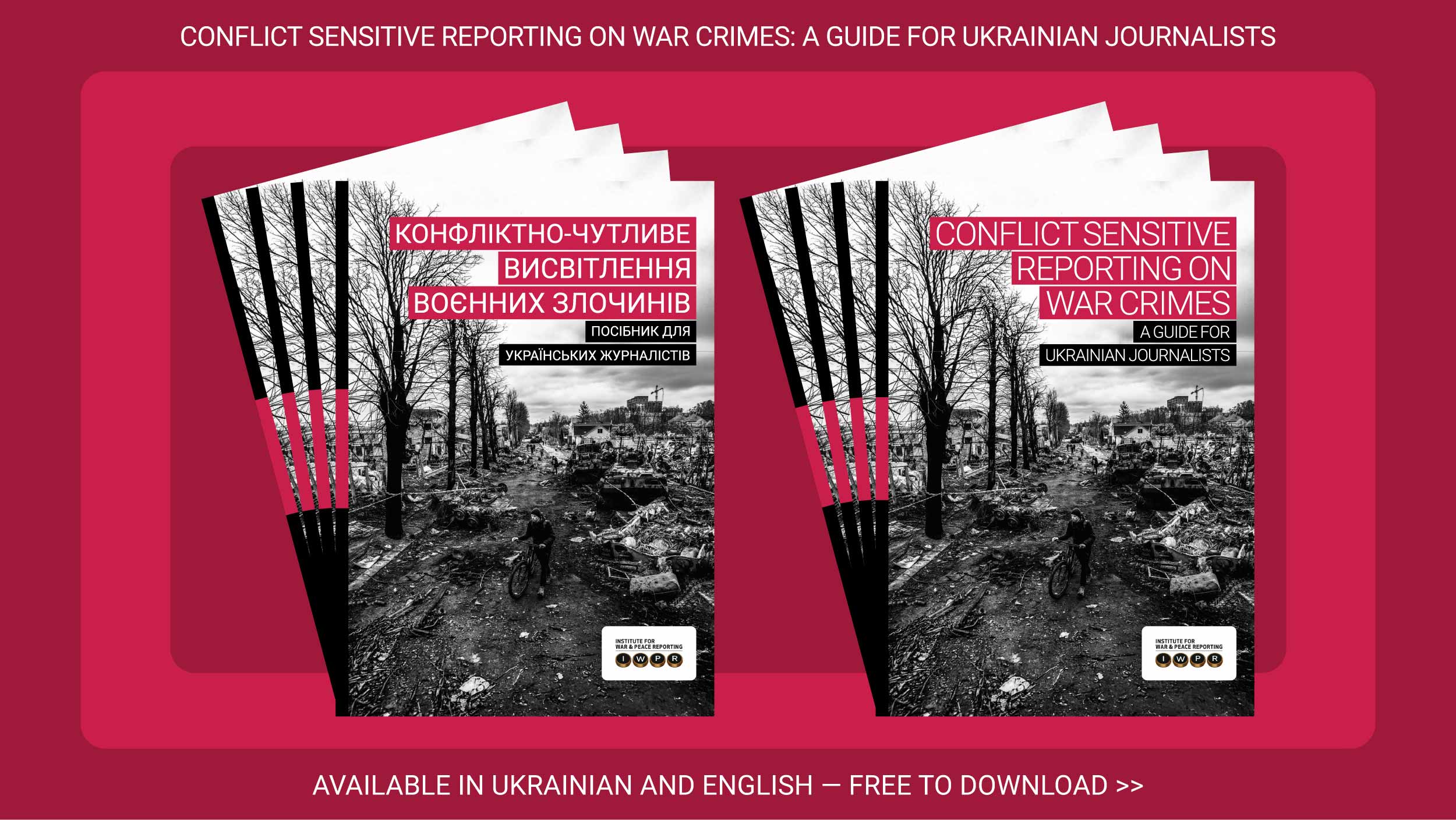
Launched at an IWPR conference in Kyiv last week featuring leading figures in the world of international justice, the user-friendly guide lays out both key concepts and best practice.
It covers issues from interviewing children and survivors of sexual violence to physical, digital and psychological safety.
Authored by Yevheniia Motorevska, head of war crimes investigations at the Kyiv Independent, and media lawyer Oksana Maksymeniuk, it features extensive input from Ukrainian journalists sharing their own experiences, dilemmas and advice.
“It was especially nice to hold in my hands for the first time the manual with my quotes,” said IWPR contributor Olena Kurenkova. “It was a visual demonstration that my journalistic experience, acquired especially within the framework of the IWPR project, can be relevant and useful to others.”
WHY IT MATTERS
Conflict-sensitive reporting requires the media to consider the safety of individuals and the pursuit of justice – and also safeguarding the journalists themselves.
“[Journalists] are the first to bring atrocities to the world’s attention, they painstakingly reconstruct events from witnesses and victims, and they do their best to keep focus on the painstaking process of seeking justice, which can extend for very many years,” Beth Van Schaack, former Ambassador-at-Large for Global Criminal Justice in the US State Department, noted in her foreword. “In the process, they may suffer injuries and trauma themselves, criticism from various sides for their coverage, and physical and emotional fatigue.”
The handbook was produced as part of IWPR’s Ukraine Justice project, supported by the UK’s Foreign, Commonwealth and Development office, which trains and mentors Ukrainian journalists to cover of war crimes justice issues.
Protecting those who document the truth is essential to sustaining credible, ethical coverage.
THE BOTTOM LINE
“The truth is that Ukrainian journalists have become experts, world leaders in the field of trauma reporting - and their colleagues around the world have much to learn from their experience,” Gavin Rees, from the Global Centre for Journalism and Trauma, wrote in an essay for the guide.
“The health of Ukrainian civil society depends on journalists continuing to pioneer a new form of journalism that is both fearless and emotionally aware.”
In times of war, how stories are told can shape not just perception, but outcomes. In Ukraine and elsewhere, IWPR’s approach to responsible reporting sees this not a constraint but as a necessity.