Ukraine: Justice in Times of War
Kyiv event brings together media, human rights defenders and international experts to discuss ethical journalism and accountability.

Also see

“Achieving Justice Means Punishing the Guilty”
IWPR guide to understanding war crimes trials launches in Kyiv.
Ukraine: Justice in Times of War
Kyiv event brings together media, human rights defenders and international experts to discuss ethical journalism and accountability.


A new IWPR handbook on conflict-sensitive reporting on war crimes for Ukrainian journalists was launched last week in Kyiv as part of a day-long conference on Ukraine’s ongoing justice efforts.
The March 19 event, at Media Centre Ukraine, brought together representatives of the judiciary, investigators, journalists, human rights defenders and international experts.
Discussions focused on developments in Ukraine’s ongoing war crimes prosecutions, prospects for international justice mechanisms, and the role of media in documenting crimes and supporting accountability.
Speakers highlighted the rapid adaptation of Ukraine’s legal system, including efforts to reduce ret-raumatisation of victims and improve investigative practices.
“To date, prosecutors and investigators have documented over 240,000 incidents of war crimes and crimes of aggression,” Yana Poliakova, a prosecutor in the War Crimes Department told the event. “This is an unprecedented number. Our practices have had to change - from evidence collection to our approaches with survivors and witnesses. It is crucial that all our evidence and future verdicts are of high quality and comply with legal requirements, particularly international humanitarian law.”
Hennadii Stasenko, head of the Borodianka District Court in the Kyiv region, described the shock to the justice system at the start of the full-scale invasion.
“No one was prepared for such challenges,” he said. “We witnessed war crimes firsthand – the Borodianka courthouse itself was destroyed by a direct hit from a Russian tank in the early days of the full-scale invasion. After the de-occupation, we had to rebuild the court’s operations, learn quickly and handle a vast number of war crimes cases.”
“The majority of crimes will be investigated at the national level, and we need to work to make our system as effective as possible,” Onysiia Syniuk, Head of the Research Department at the ZMINA Human Rights Centre, said. “But we cannot reach the highest-ranking officials domestically due to their immunities – and this is where we place our hopes in the International Criminal Court.”
Debate also addressed the limits and opportunities of international justice, while the role of propaganda in enabling war crimes was also highlighted.
Wayne Jordash KC, President of the Global Rights Compliance foundations, pointed to systematic efforts to spread disinformation about atrocities, arguing that propaganda was a key element in modern conflicts.
“Why should a person who facilitates and contributes to the commission of a crime be held less accountable than the one who pulls the trigger?” he asked. “That is the very question at the heart of the 'information alibi.'”
Journalist Alina Kondratenko highlighted the profound significance of war crimes trials for the survivors themselves, even when the accused is tried in absentia.
“Justice and the legal process are ultimately intertwined,” she said. “I often hear from survivors that justice, for them, is seeing a verdict handed down to the perpetrator, even if he isn't in the dock. It is incredibly important to them. It serves as an affirmation that they have been seen, heard and that their suffering has been acknowledged.”
A significant portion of the discussion focused on the evolving understanding of ethical communication in a society experiencing mass trauma. The speakers emphasised the need to learn new forms of communication, recognise triggers and remain attentive to the well-being of others.
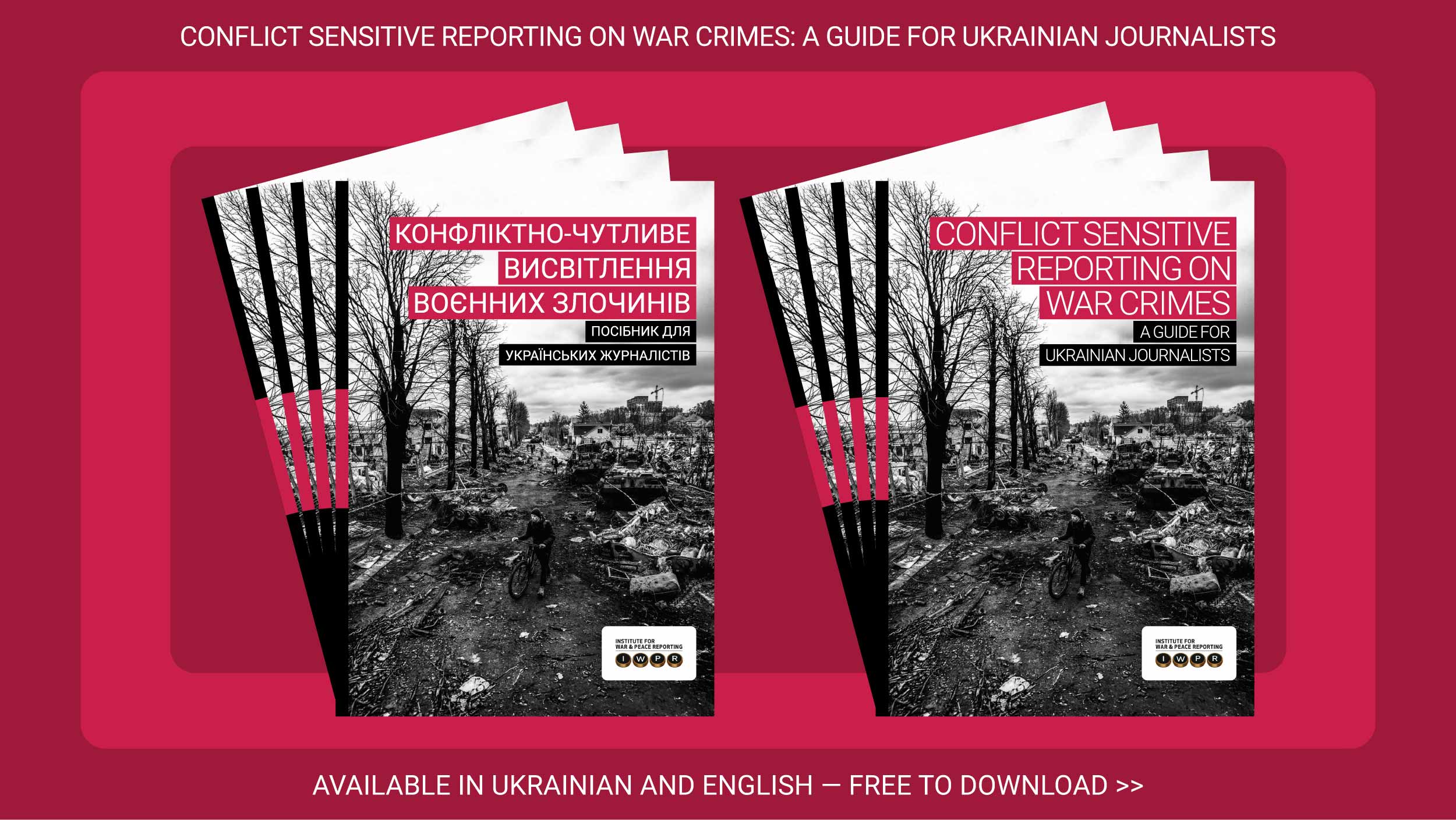
Conflict Sensitive Reporting on War Crimes: a Guide for Ukrainian Journalists is designed to address these issues in a user-friendly format laying out both key concepts and best practice.
Authored by Yevheniia Motorevska, head of the war crimes investigations unit at the Kyiv Independent and media lawyer Oksana Maksymeniuk, it features extensive contributions from Ukrainian journalists sharing their own experiences, dilemmas and advice on covering the conflict.
“It was especially nice to hold in my hands for the first time the manual with my quotes,” said Olena Kurenkova, an IWPR contributor and journalist at Suspilne Novyny. “It was a visual demonstration that my journalistic experience, acquired earlier and especially - within the framework of participation in the IWPR project, can be relevant and useful to other colleagues.”
The handbook was produced as part of IWPR’s Ukraine Justice project, supported by the UK’s Foreign, Commonwealth and Development office, which trains and mentors Ukrainian journalists to produce accurate court reporting and coverage of war crimes justice issues.
With a foreword from Beth Van Schaack, former Ambassador-at-Large for Global Criminal Justice in the US State Department, it is the sister publication to Understanding War Crimes: A Guide for the Ukrainian Public.
“This is a truly valuable resource for both experienced journalists and beginners,” said Ukrainian journalist and IWPR contributor Alina Kondratenko. “It’s extremely important that the guide pays attention to the victim-centered approach, the essence of which is focused on not traumatising victims further during documentation or interviews.”
“The guide contains a lot of useful information on how to prepare materials: from checking sources to checking photo and video evidence,” Kondratenko continued. “Each section has examples of what not to do, illustrated by real situations. It is especially important that there is a section on the safety and protection of journalists: on self-support and the importance of psychological resilience.”
“Conflict-Sensitive Reporting on War Crimes captures new practices for covering trials and communicating with people affected by Russian aggression,” added Oksana Rekun, an award-winning Suspilne journalist who works with the Swiss outlet JusticeInfo - Foundation Hirondelle. “It will be useful both for practicing journalists and for those who are just beginning to work on issues of justice.