
Ukraine: “We Keep Going”
Not one generation of my family has escaped dispossession, deportation and war.

Also see

Ukraine: “Could I Have Done More?”
What resonates is the vulnerability and the sense of guilt that people struggle with, even those who have done so much.

Ukraine: “Russia Tries to Erase Our Stories”
As long as people’s voices are heard, I think we are bringing some justice.
For my family, the war began probably at least 100 years ago. I realised recently that not one generation of my family has escaped dispossession, deportation and war.
For me personally, it was February 22, 2022; I was in London and I didn't sleep that night. My three-year-old was sleeping next to me and I just spent nine hours straight on Twitter because my mum and dad were in my hometown Khakhovka, my brother was in Kyiv, and my extended family was all over Ukraine.
I can't explain how horrific the experience was. I felt like the muscles all over my body were clinging on, hugging my bones. I was just a tight ball lying there watching, messaging, trying to call everyone.
My parents told me later on what happened. They were woken up by the explosions at 4am, and then the next day the tanks rolled into my hometown.
Khakhovka, in the south of Ukraine, is 70 kilometers away from the border with occupied Crimea. So my mum had always said, “if they come, I'm going to get my frying pan out. And I'm going to defend my house because this is my home and I'm not going anywhere.’
At first, the Russians took a slightly more lenient stance, and were not as brutal as elsewhere. My mum and dad, with a whole bunch of other Kakhovka residents, went to protests every day by the house of culture, as they call it, a big Soviet faux-Grecian kind of building.
Then at some point closer to March, the Russians started shooting into the crowd and it was no longer safe to go and protest. But my dad said that they couldn’t leave; first of all, it wasn’t safe, and secondly he had a factory that produced farming equipment with 35-40 employees.
“How are they going to work? I can't leave them,” he said. And my mom had a small B&B business in town, and they had chickens and ducks and dogs. They had an orchard, and my mom had a garden with like five types of basil and tomatoes that grew as big as a kilo.
So they refused and refused and refused and said, we're just going to wait it out.
But when the Russians cut off communication –this is when atrocities are committed, and when they can hide them quite easily – and I couldn’t contact my parents for 48 agonising hours, I had a meltdown.
I got back on the phone and I screamed. There was just no other way that I thought that I could convince them.
So I said, I'm going to die if you don't leave, and I will not be able to do anything. I will not be able to help anyone. I will not be able to look after my children. I can't go on if you don't leave.
And then that night, the Russians called my dad. And they said, we know that your son has taken up arms and if he doesn't put the arms down, there will be consequences.
My brother had never held a gun in his life, but he joined the territorial army on the second day of the invasion.
And so my mom finally relented.
My parents left first. The second day my extended family left and then my best friend left on the third day.
Normally it takes an hour to get from Kakhovka to Kherson, the regional centre. It took them close to 19 hours because of the Russian checkpoints. And they didn't strip search my dad, but young men were strip searched for tattoos and for bruises on your shoulder, you know, to see if they've been in combat.
The FSB officer comes up to the window of the car and he starts interrogating her, unblinking into her eyes. And he says, give me your passport. So she gives him her passport. And my mom said that one of the worst, most humiliating, weird things was, he said, what's your name? In her head, she thought, you're looking at my passport, my name is there! But she pretended to be dumb, just to get out of there. So she said, my name is this and this. What do you do? I'm a pensioner. Why are you leaving? My mom just wanted to spit in his face, but she said, because there's shooting.
So they got to Kherson, and then they got to Snigurivka and then they drove through Ukraine for five days through Europe to Italy where my cousin had a house. I met them there and I made them borscht.
I heard later that when the Russians came to our house and they said very magnanimously, don’t worry, we will not touch your tomatoes. We will not touch your beautiful tomatoes. We've got our own supply, so please pick them and give them to the neighbours. It still gives me the creeps. I don't know why they said that. It was just so weird.
My mom is still in Berlin with my family there. But my dad just couldn't stay; he basically got into a car and drove all the way back by himself to Ukraine. My mom and dad have known each other since primary school, got married when they were 17, 18. So that was the first time that they were apart.
But the good news is that my dad, I think, is actually doing the best out of all of us psychologically. He is an engineer, so he went to Kharkiv and got an old tractor. And he's now turned it into a minesweeper. Completely figured it out - he's extremely clever - just from, I don't know, studying some YouTube videos.
Every time I call him, he's just like, everything will be okay in Ukraine. Everything will be okay.
So it all goes up and down, but we keep going. We keep going.
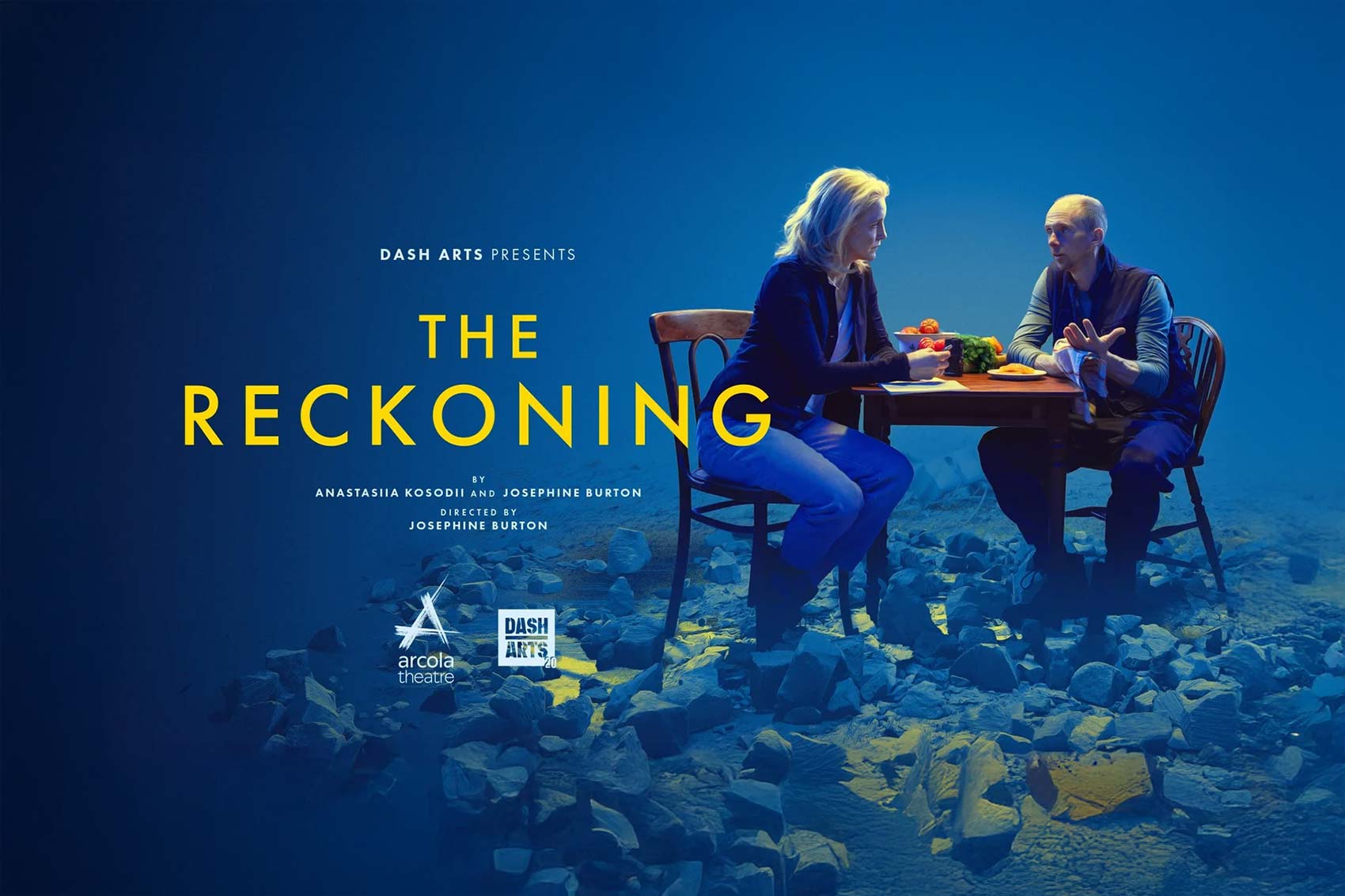
This is an edited version of Food for Thought, a series of talks given as part of Dash Arts' production of The Reckoning at the Arcola Theatre (May - June 2025). The Reckoning, a play based on witness testimonies from Ukraine gathered by The Reckoning Project.