Iran Conflict Shakes Syria
In this week’s update, read about how Syria’s fragile recovery is being impacted by the Iran war.
Also see

Iran War Threatens Syria’s Fragile Recovery
Regional escalations strain already acute economic, social and political tensions.
Iran Conflict Shakes Syria
In this week’s update, read about how Syria’s fragile recovery is being impacted by the Iran war.

Welcome to IWPR’s Frontline Update, your go-to source to hear from journalists and local voices at the front lines of conflict.
THE BIG PICTURE
When war breaks out, nearby countries often face refugee crises, economic shocks and security threats, leading to far-reaching impact.
In a country like Syria, itself recovering from more than a decade of conflict, the consequences can be even more perilous.
VOICES FROM THE FRONTLINE
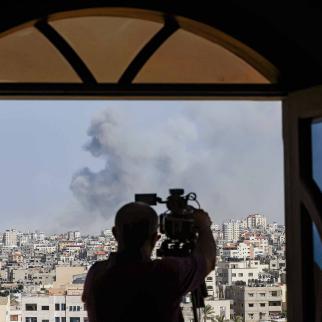
“Seeing the rockets crossing the sky above us in both directions, sometimes exploding with massive lights and sounds, was something new for me as a Syrian,” Damascus resident Rasha told IWPR’s Thanaa Jebbi this week, describing being caught in the crossfire of the Iran war. “The feeling that these rockets are not targeting us, but that we could still become collateral damage… there was a distance, but it felt surreal.”
Although the war is not being fought on Syrian territory, it nonetheless risks undermining the delicate conditions needed for its recovery.
Mohammad from Yabroud, a city north of Damascus, told Jebbi that he was particularly afraid of infiltration by armed actors, adding, “Our country is already in a critical situation, and this could create further instability.”
The war is disrupting transport routes, raising fuel and food prices and discouraging businesses in a weakened economy where many people are already struggling.
Aleppo resident Yahia Omar said this was uncomfortably reminiscent of the Assad era, adding, “Here we are again, suffering from fuel shortages because of a war that is not even on our land. We are still affected, especially because our country is already economically fragile.”
WHY IT MATTERS
While the world focuses on scenes of active conflict, the knock-on effects on vulnerable countries nearby can be devastating.
Russia’s full-scale invasion of Ukraine has led to energy insecurity, refugee inflows, and heightened political tension in Moldova, already economically fragile. During the Libyan civil war, Tunisia was heavily affected, with a drop in crucial tourism income, increased arms smuggling and wider security pressures. The Syrian war spurred an influx of more than a million refugees into Lebanon, which heavily strained the country’s already fragile balance, contributing to economic crisis and political paralysis years later.
THE BOTTOM LINE
IWPR has worked in Syria since 2007, supporting civil society and journalists navigating the conflict, crisis and transition. International attention often drifts when a country is no longer embroiled in war. But beyond the news cycle, Syria’s recovery depends heavily on complex factors that are all now at risk.
“Although Syria no longer dominates headlines, it remains deeply entangled in the dynamics of regional conflict,” wrote Jebbi. “The Israel–Iran escalation exposes the fragility of Syria’s recovery, the unresolved tensions of its recent past, and the ways in which people in Syria continue to navigate a region marked by overlapping wars.”
“For us, the war never stopped,” Mohammad continued. “It only changes shape and location.”