
Iran War Threatens Syria’s Fragile Recovery
Regional escalations strain already acute economic, social and political tensions.

Also see

Hope and Fear Among Iranians in Turkey
For many, the crisis is shaped by bitter arguments over what kind of change - if any - should come next.
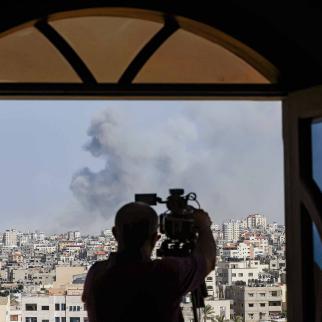
Since the start of the Iran war, missiles and interception systems have been periodically lighting up the night sky across Syria. Residents report witnessing projectiles high overhead as the conflict between Israel, the US and Iran continues.
“Seeing the rockets crossing the sky above us in both directions, sometimes exploding with massive lights and sounds, was something new for me as a Syrian,” said Rasha, a resident of Damascus. “The feeling that these rockets are not targeting us, but that we could still become collateral damage… there was a distance, but it felt surreal.”
The sense of distance from the fighting may be new. The vulnerability is not.
After more than a decade of war, Syria remains economically and socially fragile. Any regional escalation - even when indirect - carries immediate consequences.
The latest tensions have added pressure to an already struggling economy. Supply chains, fuel prices and trade routes are all vulnerable to disruption, particularly as the conflict intersects with developments in Lebanon and broader regional instability.
“The saddest thing is seeing the long queues for gas cylinders again,” said Aleppo resident Yahia Omar, a 45-year-old shop owner. “This scene is deeply tied, in our memory, to the Assad regime era - but here we are again, suffering from fuel shortages because of a war that is not even on our land. Still, we are affected, especially because our country is already economically fragile.”
With flights suspended or rerouted due to security concerns, many have found themselves unable to leave or return, adding another layer of uncertainty to daily life.
“I went on a short work trip and never imagined I would be stranded outside the country, far from my children, for ten days,” said 29-year-old Maya, who was on a work trip to Europe when the war began and struggled to return to her home in Daraa, southwestern Syria. “I tried different ways to return and reunite with my kids and partner. It brought back all my fears about stability and settlement in Syria.”
For a country still attempting a fragile and uneven recovery, such shocks are not temporary disruptions; they deepen existing vulnerabilities.
For some, the escalation is viewed through the lens of Syria’s own recent history. Iran’s role in supporting the Assad government during the Syrian war remains a defining memory, shaping how some interpret current events.
“Justice or God’s revenge has finally come for the Iranian regime,” said Sofian, a 32-year-old software engineer living in Deir Ezzor in eastern Syria. “They killed and tortured thousands of Syrians during the revolution, and their support was a main reason the fall of the Assad regime was delayed for years. I feel relief seeing bombs falling on them and members of their regime being killed.”
This perspective sometimes extends to a sense that the weakening of Iran represents a form of historical reckoning. At the same time, others draw a clear distinction between the government in Tehran and the Iranian people, expressing sympathy for opposition movements inside Iran and hopes for greater freedoms.
“It is sad and shameful to see Syrians who themselves suffered from dictatorship and war gloating over the suffering of Iranian people,” said Asmaa Hasan, a 45-year-old community worker from Idlib. “We must distinguish between regimes and civilians.”
Others are deeply uncomfortable with the nature of the escalation itself. While critical of Iran’s role in Syria, they also view the conflict through a broader geopolitical lens.
Iran has functioned as part of a regional balance of power, particularly in relation to Israel, and its weakening raises concerns about a future dominated by a single actor.
“I am really worried about the increase in Israeli dominance in the region,” said Halim Samir, 35, a teacher from Latakia in northeaster Syria. “If they win this war and remove the Iranian regime, despite all my opposition to it, the balance in the Middle East will be lost, and the idea of a ‘greater Israel’ will become closer.”
Others see the war not as a struggle between justice and injustice, but between competing powers whose actions have all contributed to violence and instability in the region.
“Both sides in this war are criminal regimes that have committed human rights violations,” said Fatima Ameen, 52, a doctor from Homs[TJ2] , in the west of the country. “None of them has the right to drive the region into more conflict - especially the US, which speaks of democracy and human rights but has shown otherwise.”
These sometimes contradictory reactions reflect not only political positions, but also the complex ways in which people in Syria continue to process their own war.
The escalation has also had indirect effects through Lebanon, where renewed violence in the south has led to new waves of displacement.
For many in Syria, watching displacement unfold in a neighbouring country carries particular emotional weight. But reactions, once again, are divided.
Some point to Hezbollah’s role in Syria, suggesting that communities once aligned with such intervention are now experiencing similar consequences.
“The displacement that Hezbollah supporters are experiencing now is similar to what thousands of Syrians went through because of the Assad regime and Hezbollah’s involvement and crimes in Syria,” said a 67-year-old farmer from the Damascus countryside. “This is justice to live part of what they made others live. This is what we went through.”
Others, however, feel empathy shaped by their own experiences of forced displacement.
“There is nothing more painful than forcing civilians to leave their homes because of war,” said Asma Hasan, adding, “My thoughts and prayers are with them.”
This tension is also reflected in debates around the situation on the Syrian–Lebanese border. While some argue that security concerns justify tighter controls, particularly given fears of infiltration by armed actors, others emphasise the need for a humanitarian response.
“I am worried about the possibility of Hezbollah members infiltrating into Syria,” said Mohammad, a 24-year-old university student from Yabroud, a city north of Damascus. “Our country is already in a critical situation, and this could create further instability. It is the responsibility of the authorities to strengthen control over the border with Lebanon.”
These debates highlight how unresolved Syria’s own displacement crisis remains and how it continues to shape responses to new crises across the region.
Although Syria no longer dominates headlines, it remains deeply entangled in the dynamics of regional conflict.
The Israel–Iran escalation exposes the fragility of Syria’s recovery, the unresolved tensions of its recent past, and the ways in which people in Syria continue to navigate a region marked by overlapping wars.
“For us, the war never stopped,” Mohammad continued. “It only changes shape and location.”