
“The City Feels Terrifying”
The question that occupies all our minds is: what is going to happen?
Also see

“We are Overwhelmed by Despair”
One woman’s account of the “intense anxiety” of life under heavy bombardment in Tehran.

“Armed Officers Are Everywhere”
Even in this situation, we still hope for a bright and free future for Iran.

“Why Did Iran Come to This Point?”
Sometimes I think how good it is that my husband passed away last year and did not live to see this.
We live in an atmosphere of fear and hope. But my fears outweigh my hopes. Every morning I wake up to the sound of explosions and fighter jets. At night I fall asleep to the same sounds, and suddenly at 5 am I jump awake again because of an explosion. Then again at 8 am, 9 am.… the explosions rarely stop for more than two or three hours. The question that occupies all our minds these days more than anything else is: what is going to happen?
Daily life is almost gone. Sleep is badly disrupted and very fragmented. I sleep no more than three or four hours in a whole day. The only upside is that since I don’t really sleep, I don’t have nightmares either. I have no appetite and can’t eat. Most days I stay at home, and if I go out I return very quickly. The streets are empty and silent, and shops are rarely open.
Social interaction has become very limited. Most people don’t move from their homes and stay where they are. Some people gathered together in one place from the first days and are living together. Others meet the same few people for an hour or two each day and then go back home. Mostly we check on each other by phone. The internet is cut off and we cannot use messaging apps. We get news from each other and ask which places have been hit. Whoever has information shares it with others. News spreads by word of mouth.
Supermarkets are open in most neighborhoods, and at least one bakery as well. Online shopping is completely unavailable. The apps still work, but stores no longer sell online—probably because they don’t have couriers to deliver orders. Prices have risen. Yesterday I went to the supermarket and every item I bought had increased by at least 50,000 tomans (40 US cents).
Only a few restaurants are open in the city. On one street I often visit there used to be seven or eight restaurants—now only one is open. On another street that used to be full of cafés, only two or three remain open. The streets are empty, cold and frightening. They are full of security patrols standing with guns. Some have armoured vehicles. The city feels terrifying. Sometimes patrols stand even in the middle of highways. They had blocked part of the Niayesh Highway and set up a patrol there.
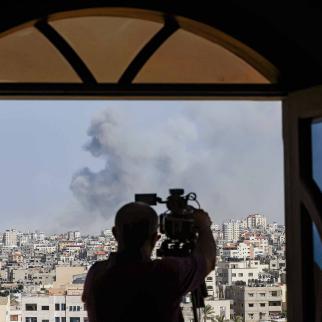
When I hear the sound of fighter jets, intense anxiety attacks me. But as soon as I go up to the roof to see where the strike happened, my anxiety somehow decreases. It’s as if I want to see what is happening to us, and that calms me. Columns of smoke keep rising across the city in different places. Our windows are double-glazed and we haven’t taped them, but some of my friends have taped theirs. Some people are more cautious; others just take their chances. Air-raid sirens sound in some parts of the city, but they are meaningless because we have no shelters to go to. There is nowhere except our homes to stay. Some domestic websites publish advice about what to do during attacks, but I don’t think many people read them. People mostly talk with each other about these things and rely on each other’s experiences. They trust one another more than what the government tells them.
Compared with the 12-day war, this is far more terrifying. The intensity of the attacks and the hours during which we are targeted have increased a lot, and everything is unpredictable. Yet compared with the previous war, fewer people around me have left Tehran. In this war most people have stayed in their homes—even though the attacks are broader and the explosions stronger.
Most of us watch Persian-language TV channels from outside the country. I also read domestic news agencies to see what is happening within the ruling system—for example, the issue of Khamenei’s succession. To find out which areas of the city have been attacked I read domestic outlets, but for the rest of the news I prefer to follow foreign Persian-language television. Their reports are more accurate. I also follow news about the Islamic Republic’s attacks on other countries through these channels.
No one feels the spirit of the [Persian] New Year. In fact the one thing we don’t talk about is the holiday. Many homes are filled with dust from explosions, and people have to clean smoke and dust from the war every day. Spring cleaning and Nowruz celebrations feel very far from our minds in these conditions.
The author is a writer in her 40s living in Tehran.
This is an edited version of an article that originally appeared in Aasoo.