
Mothers, Medics, Entrepreneurs: The New Face of Mosul
Economic empowerment fuels a new chapter for women in a city once ravaged by war.

Also see

Turkey: Plaiting As Protest
Women’s willingness to alter their hair in solidarity with those suffering violence is “an alternative method of writing history”.

“How Can There Be Peace Without Us?”
Conflict creates catastrophic, gender-specific crises, with women from minorities even worse impacted.

Ukraine: “My Only Goal Was to Survive”
One woman’s experience of enduring Russian captivity and pursuing her abuser through the courts.

Syria: Be Exceptional, or Be Invisible
In Syria as elsewhere, women are granted dignity selectively.

Kazakhstan: “I Was Treated Like Property”
Civil society campaigns for a clear legal definition of sexual harassment that would allow abusers to be held accountable.
In the summer of 2017, as the battle to liberate Mosul from the Islamic State (IS) raged on, Sorour entered the city’s historic core, on the right bank of the Tigris river, alongside security forces.
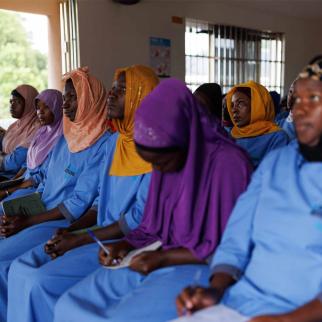
A trained nurse, her task was to help recover civilians trapped under debris and inside destroyed buildings – whether alive or dead.
She recalls the director of the municipality exclaiming in disbelief, "You're a girl - how can you bear to carry a corpse?"
The task of retrieving bodies was considered men’s work, but Sorour understood that her presence served another purpose: preserving the dignity of the survivors.
“The wounded who saw me, most of whom were women and children, did not care about their injuries as much as they wanted me to just cover them with something. They were relieved by the presence of a woman among the army,” she recalled.
Sorour spent five months working in neighbourhoods ravaged by bombings and formed her own volunteer team aimed at retrieving unidentified bodies. After the liberation of Mosul, Sorour returned to nursing but also began training locals in first aid.
“People didn’t know even the simplest rescue steps,” she concluded.
Even after IS was defeated, the repercussions of the 2014-2017 occupation continued to be felt across Mosul. Women bore the heaviest burden; many suddenly found themselves facing life without a partner or a source of income.
According to Nadia al-Jubouri, former advisor on women's and children's affairs in Nineveh province, out of approximately 45,000 widows and divorcees in the city, only 23,000 receive any state support. She added that as many as 10,000 women were unregistered and thus outside protection networks or any support system.
Many women entered the labour market, in turn heralding a transformation that extended to the city’s social structure itself. Employment opportunities redistributed family roles and reshaped social relationships, opening space for new forms of independence.
“Not only has the door been opened to women, but door itself has changed,” said Rafiah Muhammad, director of the Women's Empowerment Department at Nineveh governorate. Job opportunities were no longer limited to nursing, teaching, sewing and beauty salons but extended to fields previously unfamiliar to women.
“Three years of violence left pent-up psychological pressure in women's bodies, and after liberation, they found in work—any work—a space for release and healing,” said women's rights researcher Suzan Aref.
On the streets of Mosul today, women can be seen, cooking and selling food, working in bakeries or running restaurants. Others have found their way into civil society organisations and joined volunteer teams alongside men, while some have turned to agriculture or dairy and food production.
“The Spirit Of Mosul in Cooking”
In the modest neighbourhood of Al -Muharibin, the aroma of Mosuli cuisine drifts from the windows of a house converted into a small factory. Um Yamama, 49, never imagined that the recipes she used to spoil her family with would one day become a source of income for dozens of women.
Before the war, she lived comfortably. But displacement and loss forced her to start from scratch.
Despite having no formal qualifications, she said had something else – “the spirit of Mosul in cooking”.
In 2018, Um Yamama turned her home into a space for food production, initially employing two workers. After word spread of her talents on social media, orders began arriving from across Iraq.
“Mosul food is in demand even among customers from the south,” Um Yamama said.
She went on to launch Safartas, a home-based cooking business staffed entirely by women. In conservative Mosuli society, such projects were traditionally run by men, but “there is no shame in working,” Um Yamama insisted.
In 2019, she began offering free cooking classes, encouraging women who had long been confined to the home to turn their skills into a business.
Starting Point
Naba, a 23-year-old student, was looking for a way out of the financial hardship that hit her family after their return to Mosul.
She came up with a simple project: selling handmade gifts online. But she had no capital and no marketing experience, let alone management skills.
“I didn't know how to promote,” Naba explained. There were days when I couldn't handle the number of orders, so I had to turn them down.”
When she failed to win a place in a competition to fund small businesses, she realised that she needed to study, and began attending lectures on business administration and economics.
With a loan from her family, she launched her outlet and later developed the Starting Point initiative, in partnership with others who believed in her vision. She now acts as a mentor, offering free consultations to novice entrepreneurs.
In contrast, Rushd, 28, was not looking for additional income when she launched the Women's Club, her project on the left bank of Mosul, with a team of three others. She just wanted to provide a safe space for mothers and their children, away from daily pressures.
After becoming a mother, she often wondered, “Where do women go after work, after the exhaustion of housework, after motherhood?”
Restaurants and recreational areas, if they exist at all, rarely welcome children or provide an environment that caters to their needs.
Rushd continued, “When a mother has a child, her leisure ends… girls in Mosul don't have many entertainment options. There is no place where they can enjoy meeting their friends and catch a breath of fresh air.”
Despite critics who dismissed her project as unnecessary, the Women's Club now hosts activates and workshops on candle making, cake decorating, crochet and painting, welcoming as many as 150 visitors each month.
Maryam, a woman in her thirties, also defied a male-dominated field to build a successful interior design business.
“They see you as a vulnerable girl who can be exploited and who cannot assert her rights, but with time you learn,” she said.
Since childhood, Maryam said she had been drawn to colours, detail and design.
“I had energy I wanted to express, but I didn't know how,” she explained.
An invitation from her mother's friend to coordinate a birthday party inspired Maryam to launch her own project. She asked one of her first clients for 75,000 dinars (60 US dollars) to buy supplies and built up her Merymana event management business.
After only a year, she was offered a job at one of the city's largest event halls – previously an unimaginable prospect.
Rafiah Muhammad noted that such transformations were not possible before the war, when few women participated in the labour market. Rising poverty rates and the absence of breadwinners in many families had changed that dynamic.
“Society now sees women's work as a necessity, not a luxury,” she said.
This article was prepared by IWPR partner Jummar, an independent Iraqi media outlet.