Iran: Regional Chaos Spreads
In this week’s update, hear from IWPR staff in the Middle East on the impact of the Iran war across the region.
Also see

Lebanon: Dancing with the Coffins
“We Lebanese are often praised for our resilience. But that should not mean accepting endless suffering.”
Iran: Regional Chaos Spreads
In this week’s update, hear from IWPR staff in the Middle East on the impact of the Iran war across the region.

Welcome to IWPR’s Frontline Update, your go-to source to hear from journalists and local voices at the front lines of conflict.
THE BIG PICTURE
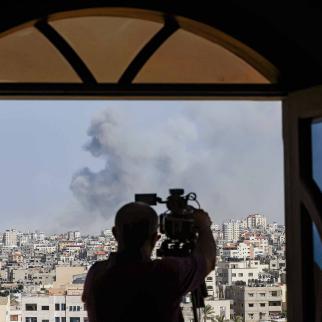
As Israel and the US continue striking Iran and as casualties rise, the repercussions are being felt across the Middle East.
There is mass displacement in Lebanon, continuing retaliatory air attacks on Israel and fears of further instability in both Iraq and Syria, while Iranian missiles and drones hit sites across the Gulf.
VOICES FROM THE FRONTLINE
“People are exhausted and afraid,” said Dahlia Khoury, IWPR’s Beirut-based Lebanon and Syria country manager. “There is a huge consensus that we didn't want to get involved in this war.”
Some 700,000 people have already fled their homes, she continued.
“The Israelis started to tell people to leave north of the Litani river; they probably plan to move deeper into Lebanon,” Khoury said. “People didn't even have the time to rebuild from the war a year ago, and now they are having to leave their homes again.”
Thanaa Jebby, IWPR Syria programme manager, explained the impact of this displacement on her own country.
“Some argue that closing the Syrian Lebanese border is necessary for security reasons, fearing infiltration by Hezbollah-affiliated actors, while others believe that people fleeing war should not be turned away,” she said.
“Syria is already in a very fragile economic situation, and global shocks affect the country much more heavily than elsewhere. The war has added further pressure on an already vulnerable population.”
“Iraq has become yet another front line,” explained Nadia Samet-Warren, IWPR Middle East and North Africa country director. “The Kurds are being pressured to get involved, although what that would look like is still unclear. A lot of Iranian Kurdish armed groups have forces operating along the Iraq-Iran border and Iran's reaction has been to continuously attack Kurdistan.”
Samet-Warren noted that Iran’s ongoing strikes on the Gulf had so far been met with a muted response.
“The Gulf countries would like to see Iran contained but not necessarily destroyed, and they most certainly won't want to be dragged into the conflict,” she said.
WHY IT MATTERS
“Across the region, casualties are mounting, with civilian and combat zones of war quickly becoming indistinguishable,” wrote Reza Akbari, IWPR Middle East and North Africa programme manager, in an analysis this week, noting that while the Islamic Republic was “arguably more vulnerable than at any time since its inception” its institutions had not fractured.
“We’re living in a period of extreme uncertainty,” agreed Samet-Warren. “Iran, a country of over 90 million people country collapsing, leading to potentially civil war, would cause chaos in the entire region.”
THE BOTTOM LINE
For more than two decades, IWPR has supported local voices and civil society across the Middle East and North Africa to respond and survive the far-reaching consequences of repeated waves of conflict, displacement and repression.
“War can disrupt, eliminate individuals, and redraw strategic calculations, but it cannot magically conjure up a stable political future,” wrote Akbari. “For now, I count the dead and hope that the next bomb will be the last.”